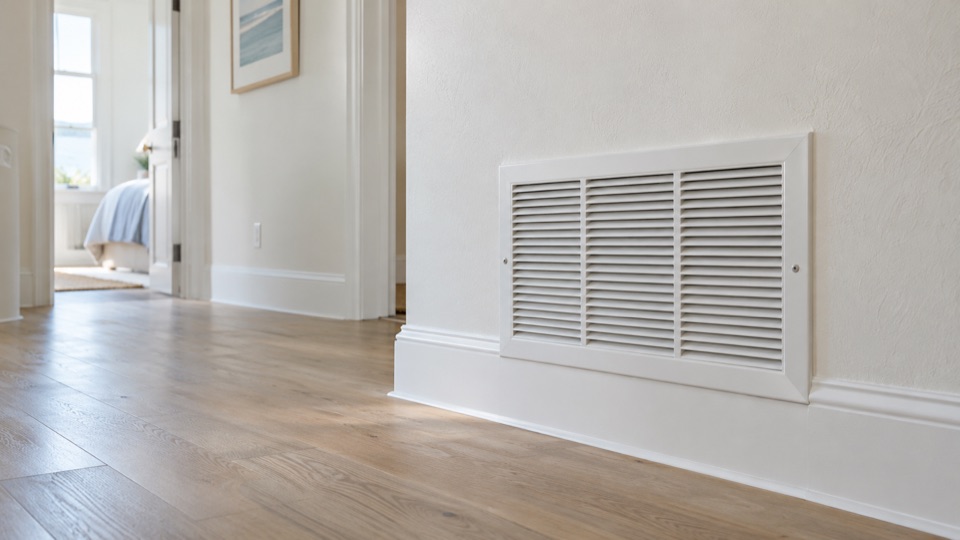
Is a cold room evidence that the blower has failed?
Not by itself. First separate weak air from air that moves normally but is not warm. Then note whether the issue affects every outlet or only part of the home. The pattern guides testing; it does not name a failed part.
Map the occupied rooms
Make a short room list using names that make sense at the property: front bedroom, hall and living room, for example. Note where air is absent, weak or apparently normal. A room-by-room description is more useful than saying the unit is underpowered.
Record whether the pattern began after furniture moved, a filter changed or building work finished. Describe what changed without removing grilles or reaching into ducts. Do not enter an attic to look for a disconnected run.
Look only at accessible obstructions
Look for a rug, curtain or furniture over a return or outlet. Check a filter only if the manual allows it and the user-service opening is easy to reach. Turn the system off first and follow those instructions.
Do not run the system without its required filter, add extra layers or choose a denser filter as an experiment. Filter fit and the allowed type are questions for the equipment instructions. A newly installed filter is useful history; it is not evidence that the rest of the air path is clear.
Ask what the airflow check found
Request the evidence that separates a blower problem from a restricted or damaged air path. If only one branch is affected, ask why work at the main cabinet would resolve that room. If all outlets are affected, ask how the fan command, motor operation and restrictions were checked.
A replacement motor recommendation should name the equipment model and compatible control arrangement. A duct plan should name the affected section. Sound alone and a hand held at one register do not settle those choices.
Include the route to the repair
Tell us whether the cabinet is reachable from a room, a closet or another access point. Describe a ceiling opening only if you already know it exists. Do not cut a new opening before the fault location and access plan are agreed.
Confirm who handles any duct access, insulation, ceiling patching or finish repair. These tasks need a clear scope alongside the equipment work. If the room problem persists after a planned repair, ask which operating check will show that the original complaint has been addressed.
Questions about this repair
Can a clean-looking filter rule out an airflow problem?
No. Filter condition is one observation. The blower, duct path and control still need to be checked when airflow remains poor.
Should every room feel exactly the same at its grille?
A hand test cannot establish the correct airflow for each room. Explain the comfort difference and ask for a check suited to the installed distribution system.